
FOB, CIF or DDP: Picking Terms for a Panel Shipment
Three letters on a quotation decide more of the landed cost than most buyers expect, because they set who books the vessel, who insures the cargo and who clears it at destination. Dongstar publishes three terms on its structural panel page — FOB, CIF and DDP — and keeps the panel specification identical across all of them. The choice is about route, paperwork and risk, not about board quality.

Key takeaways
- FOB, CIF and DDP are all available on the structural panel page, and all three cover the same published panel build.
- Whichever term applies, packing is palletised, wrapped and trucked into containers at port.
- The mill can book freight on the buyer's behalf or load to the buyer's appointed forwarder, so the term is a choice rather than a constraint.
- Lead time runs two to ten weeks from confirmation and deposit, and does not shorten because a term was selected earlier.
Three terms, three handover points
FOB, CIF and DDP are often discussed as if they were price levels on the same offer. They are better read as handover points on a route. Under FOB the seller delivers the goods to the port of shipment and the buyer takes over carriage, insurance and import clearance. Under CIF the seller arranges and pays for carriage and insurance to the destination port, while the buyer still handles import formalities. Under DDP the seller carries the goods further still, through import clearance to the agreed delivery point.
Each step a seller takes on is expensive and slower to arrange on the buyer's behalf, but each step also removes an operational risk the buyer would otherwise hold. A first-time importer with no freight relationships gains the most from a term that moves the vessel booking away from them. An experienced importer with a consolidator and a broker may simply prefer to keep control and pay less for the same route.
Where FOB ends and CIF continues
The practical difference is felt at exactly one moment: when the container leaves the port of loading. Under FOB, the buyer's exposure starts there and their forwarder is on the hook for the ocean leg. Under CIF, the seller has already booked and insured that leg, so a rolled booking or a missed cut-off is the seller's problem to resolve, and the buyer's cost is embedded in the price rather than appearing on a separate invoice.
For panel cargo the route detail matters because the goods are heavy and the packing is fixed early. Palletised and wrapped packs are sized for the container during production, so a change of vessel or port after packing is a cost on the seller's side rather than a chance to repack. Buyers negotiating CIF should ask which route and which transhipment points are covered, because the term is only as good as the routing behind it.
DDP moves the paperwork, not the panel
DDP is the term buyers choose when a project needs panels at a site address and the organisation has no appetite for customs work. The seller's scope widens to include import clearance and onward delivery, which means the buyer's landed cost becomes one number and their internal administration shrinks to a goods-in process. The trade-off is transparency: duties and clearance costs are inside the price, so the buyer cannot see what would be saved by handling them directly.
Nothing in the panel specification changes between the three terms. Sizes, construction and the published certificate set stay the same, and the two-to-ten-week production window still runs from confirmation and deposit. Selecting DDP does not buy a shorter production slot, and selecting FOB does not buy a longer one.
The construction behind the quote is worth reading once, because it is what the freight is carrying. Dongstar publishes a cross-laminated veneer structure that lifts bending strength and dimensional stability and holds the panel flat under pressure, and a Doka-grade structural plywood build processed for a high number of reuses with a smooth, even concrete face. Those are the properties a project buys; the term only decides how the boards reach the site.
The six reasons the structural page gives project buyers
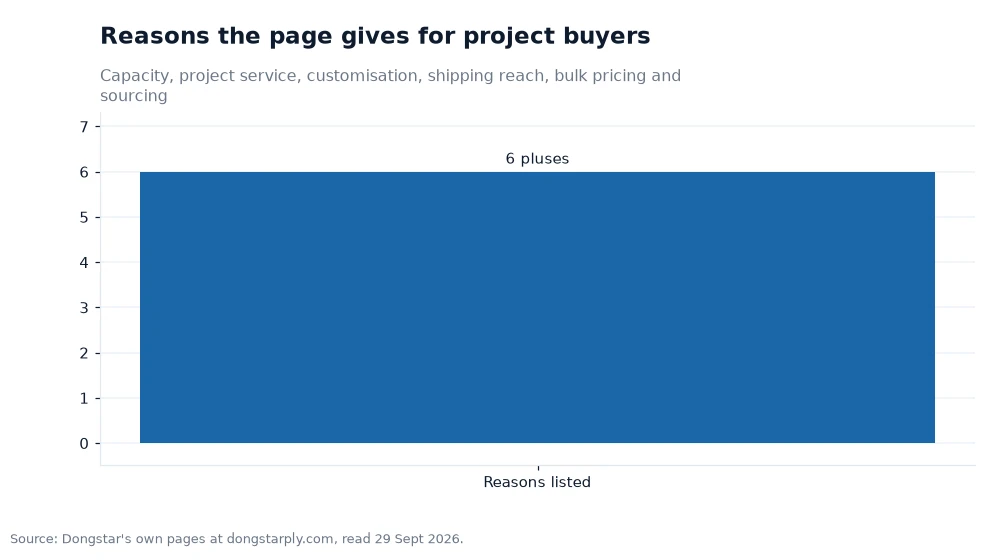
The page lists the case for the panel itself separately from the terms, and the list runs to six points: capacity and dedicated production lines that can serve container volumes with stable lead times and bulk pricing; project-oriented service covering documentation, QA reports, freight tracking and optimised packing; customisation of sizes, branding and special faces; worldwide shipping with container support; bulk pricing where volume allows; and sustainable sourcing with certification support.
Read together, those six points describe a supplier set up for project schedules rather than for one-off sales. Documentation, QA reports and freight tracking are the parts a site manager feels when something goes wrong; capacity and bulk pricing are the parts a procurement team sees in the order form. Buyers comparing two suppliers on price alone rarely see either half, which is why the list is worth reading before the term is chosen.
| Term | Seller arranges | Buyer still handles | Fits a buyer who |
|---|---|---|---|
| FOB | Production, packing, inland trucking to port | Ocean carriage, insurance, import clearance, duty | has forwarder and broker relationships already |
| CIF | As above plus carriage and insurance to destination port | Import clearance and duty | wants freight risk moved off their desk |
| DDP | As above plus import clearance and delivery | Goods-in and site handling only | needs one landed number for a project |
| Any term | Palletised, wrapped packing trucked into containers | Unloading and storage at destination | should confirm packing at quotation stage |
Worked example: how the term interacts with the order area
Suppose a project requires 3,000 m² of panel and the buyer is deciding between formats before choosing a term (example quantity). In the 1250 × 2500 mm size, 3,000 ÷ 3.125 = 960 exactly, so 960 sheets cover the requirement. In the 1220 × 2440 mm size, 3,000 ÷ 2.98 = 1,006.7, which rounds up to 1,007 sheets (example arithmetic).
The difference is 47 sheets, about 140 m² of extra board if the cutting plan wastes the rounding. Now picture the same order under two terms. Under FOB the buyer's freight invoice reflects the volume actually shipped, so the extra 47 sheets are paid for twice: once as board, once as carriage. Under DDP the seller has priced the route into a single figure, and the buyer only sees the total. That is the trade the term makes: administration for visibility. Either way, the format decision should be settled first, because it changes what any term is ultimately applied to.
Frequently asked questions
Does the trade term change the price of the panel?
It changes the landed cost, not the panel. The board is quoted against the same published specification whatever the term, while FOB, CIF and DDP add different amounts of carriage, insurance and clearance into the figure the buyer pays.
Can the mill load to the buyer's own forwarder?
Yes. The structural page states that the supplier can book freight on the buyer's behalf or work with the buyer's nominated forwarder, and that packing is palletised, wrapped and trucked into containers at port. That flexibility is what makes FOB practical for buyers with existing logistics partners.
Which term suits a first import from China?
Many first-time buyers start with CIF, because it removes the ocean booking and insurance from their desk while leaving them in control of import clearance. DDP is simpler still, and the price reflects that the seller is carrying more of the risk and administration.
Choosing the term for the next shipment
Buyers weighing terms can read the manufacturing background on the company and standards pages and the wider catalogue on the range overview before committing to a route. The most useful habit is to fix the specification, then the 3 Layer Plywood format, and only then negotiate the three letters — because a term applied to an unsettled order simply prices uncertainty.
Trade terms, packing statements and project services described in this article sit on the supplier's own pages, reviewed on 29 September 2026, as the basis for the table above, as as standard quoted in this piece[1].